
What We Teach
“All the sciences and arts are ordained to one thing, namely, to man’s perfection, which is happiness.”
-St Thomas Aquinas

Curriculum Overview
St. Michael’s Academy provides a Catholic education that integrates faith and reason across every subject. Through the study of great books, mathematics, history, science, Latin, and the fine arts, students encounter the intellectual and spiritual heritage of Western civilization while learning to think clearly, speak well, and pursue virtue. Rooted in the Catholic tradition, the academy teaches that all truth is ultimately unified in God, cultivating minds and souls ordered toward wisdom, beauty, and holiness.

MATHEMATICS
-
Mathematics train the mind to seek objective truth, order, harmony, and intelligibility. It has traditionally been recognized as a discipline that prepares the intellect to grasp realities that are eternal and unchanging. Plato famously had the inscription “Let no one ignorant of geometry enter here.”carved on the door of his academy in Athens.
In De Institutione Arithmetica, the martyr Boethius teaches that mathematics elevates the mind above the changing world of the senses and directs it toward eternal realities. Likewise, St. Augustine drew upon mathematical truths in formulating his famous Argument from Eternal Truth, reasoning that immutable truths point beyond the human mind to God Himself. Through the study of numbers, patterns, and proportions, students learn to think clearly about objective truths that cannot be seen or touched.
-
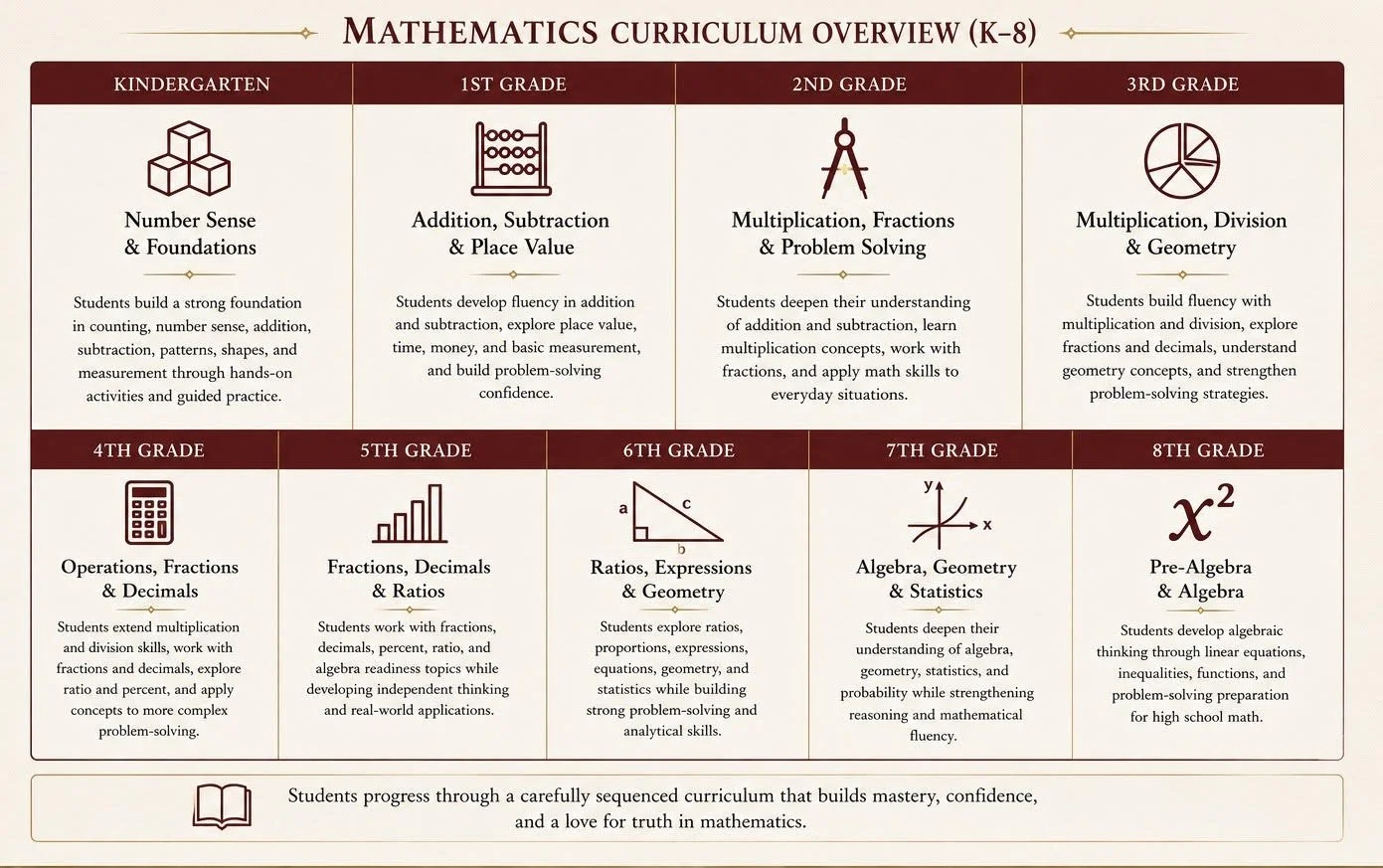
Younger students focus on Number Sense and Foundations, Addition, Subtraction, and Place Value, Multiplication, Fractions, and Problem Solving.
Our intermediate students then begin learning Operations, Fractions, and Decimals, ratios, and expressions.
While our older kids work on geometry, pre-algebra and algebra
-
Boethius, St Augustine, St Albert the Great, Rene Descartes, Blaise Pascal
LITERATURE
-
The literary arts have always had a special place in the Church’s tradition. As Pope Benedict XV notes, there are “many celebrated geniuses of whom the Catholic faith can boast who have left undying fruits in literature and art especially, besides other fields of learning, and to whom civilization and religion are ever in debt” (In Praeclara Summorum). From Dante, to Tolkien, the Catholic Church has always produced the greatest literary artists of the West. Great stories reveal enduring truths about human nature, virtue, vice, and the consequences of our choices. Through literature, students encounter noble examples, wrestle with moral questions, and develop the imagination necessary to perceive what is good, true, and beautiful.
-
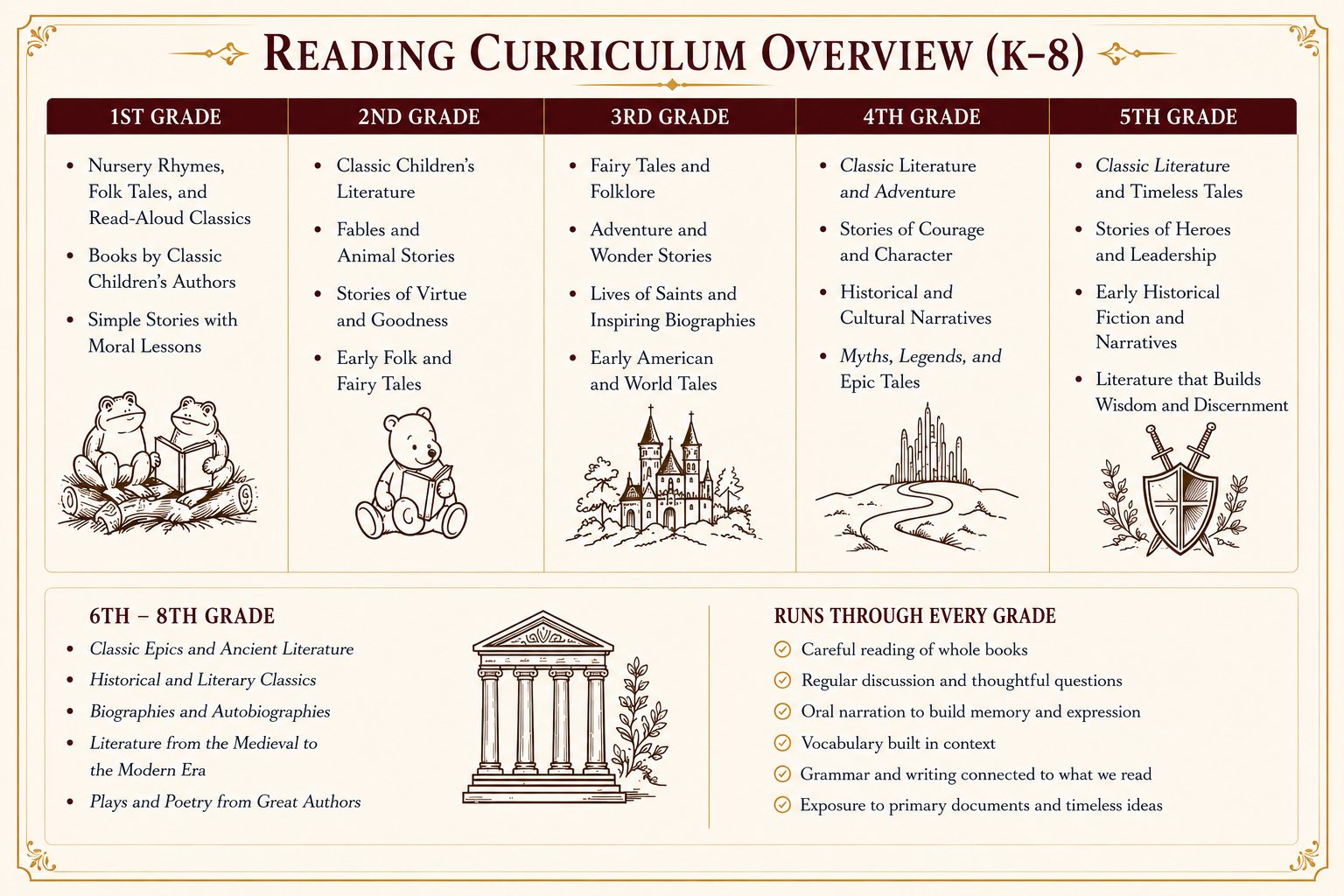
Students begin with classic children's literature, fairy tales, fables, folk tales, and read-aloud classics.
Students transition into longer works of literature and adventure stories while exploring history, mythology, and cultural narratives.
Our older students encounter some of the most influential works of Western literature and thought. Such as Homer, and Virgil.
-
Dante Alighieri, William Shakespeare, GK Chesterton, JRR Tolkien, Flannery O’Connor
SCIENCE
-
As Aristotle notes in the Metaphysics, that, “ All men desire to know.” The Catholic intellectual tradition has long encouraged the study of the natural world, contributing significantly to the development of astronomy, physics, mathematics, medicine, and the scientific method. Some of the most advanced scientific discoveries such as the heliocentric model of the universe, Big Bang theory, the scientific method, etc. were all developed by Catholics. Guided by this heritage, our science curriculum seeks to cultivate wonder, intellectual humility, and disciplined reasoning. Students learn not only how the world works, but also how scientific knowledge fits within a broader understanding of reality, one that recognizes both the material order studied by science and the higher truths revealed by faith.
-
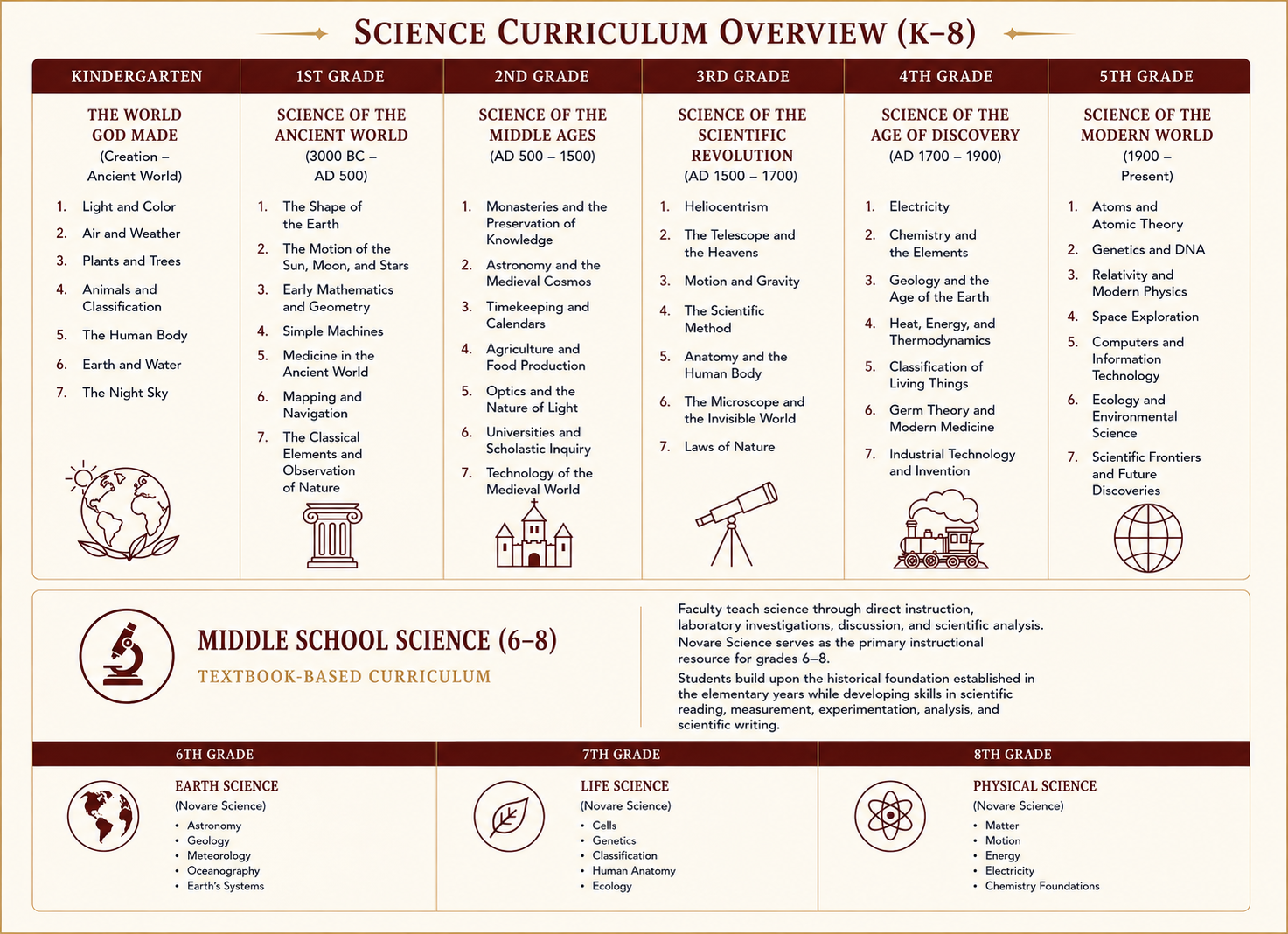
The Academy's lower school science curriculum has been developed in-house and follows the historical development of scientific knowledge. Rather than presenting scientific facts in isolation, students encounter many of the major discoveries that transformed mankind's understanding of the natural world.
Beginning in sixth grade, students transition to a more formal study of science through laboratory investigations, quantitative analysis, scientific reasoning, and technical writing. Novare Science serves as the primary instructional resource while faculty provide direct instruction, discussion, demonstrations, and laboratory experiences.
-
St Albert the Great, Nicolaus Copernicus, Roger Bacon, Nicolas Steno, Gregor Mendel, Georges Lemaître
HISTORY
-
History is the unfolding of God’s providence in time. History is not merely a record of political events or human achievements, but the stage upon which God guides nations, disciplines peoples, and prepares the world for Christ and His Church. The study of history helps students understand God’s providence, and his guiding hand in time. Students learn from the virtues and failures of those who came before them, and appreciate the inheritance of faith, culture, and wisdom that has shaped the Christian world. By studying great men and women, nations, and events, students develop prudence, gratitude, and a deeper understanding of their duties as Christians and citizens, recognizing that they are heirs to a rich tradition and stewards of its future. Starting from a micro and going to a macro scale, beginning in their own homes and ending in greater humanity.
-
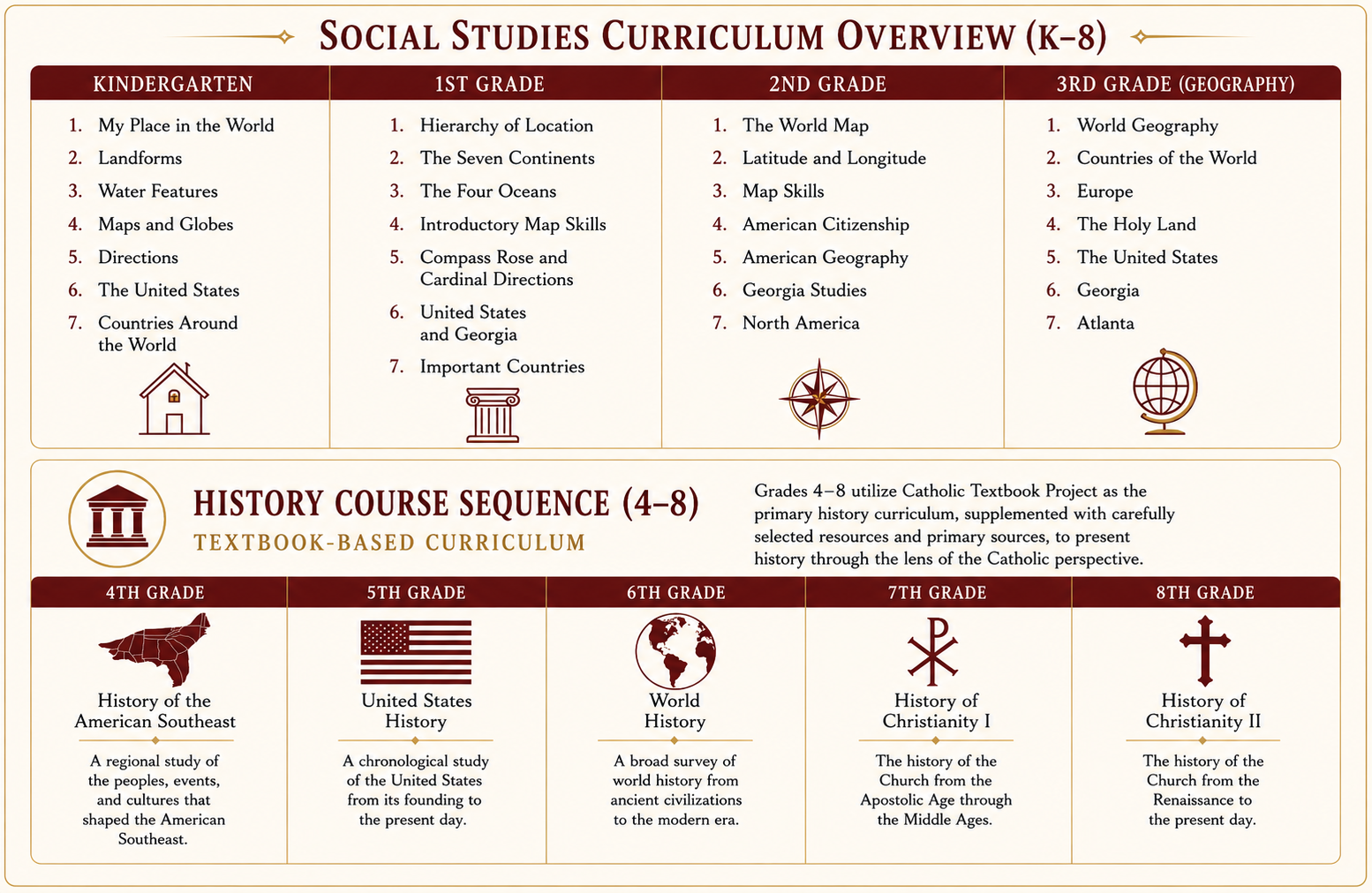
The Academy's lower school social studies curriculum has been developed in-house and focuses primarily on geography, map skills, and cultural awareness. We believe students should first develop a strong understanding of the world around them before undertaking formal historical study.
Beginning in fourth grade, students transition to a formal study of history. Teachers guide students through historical narratives, primary sources, discussion, narration, and written analysis while utilizing carefully selected instructional resources to support learning.
-
St. Bede, Christopher Columbus, St Junípero Serra
LATIN
-
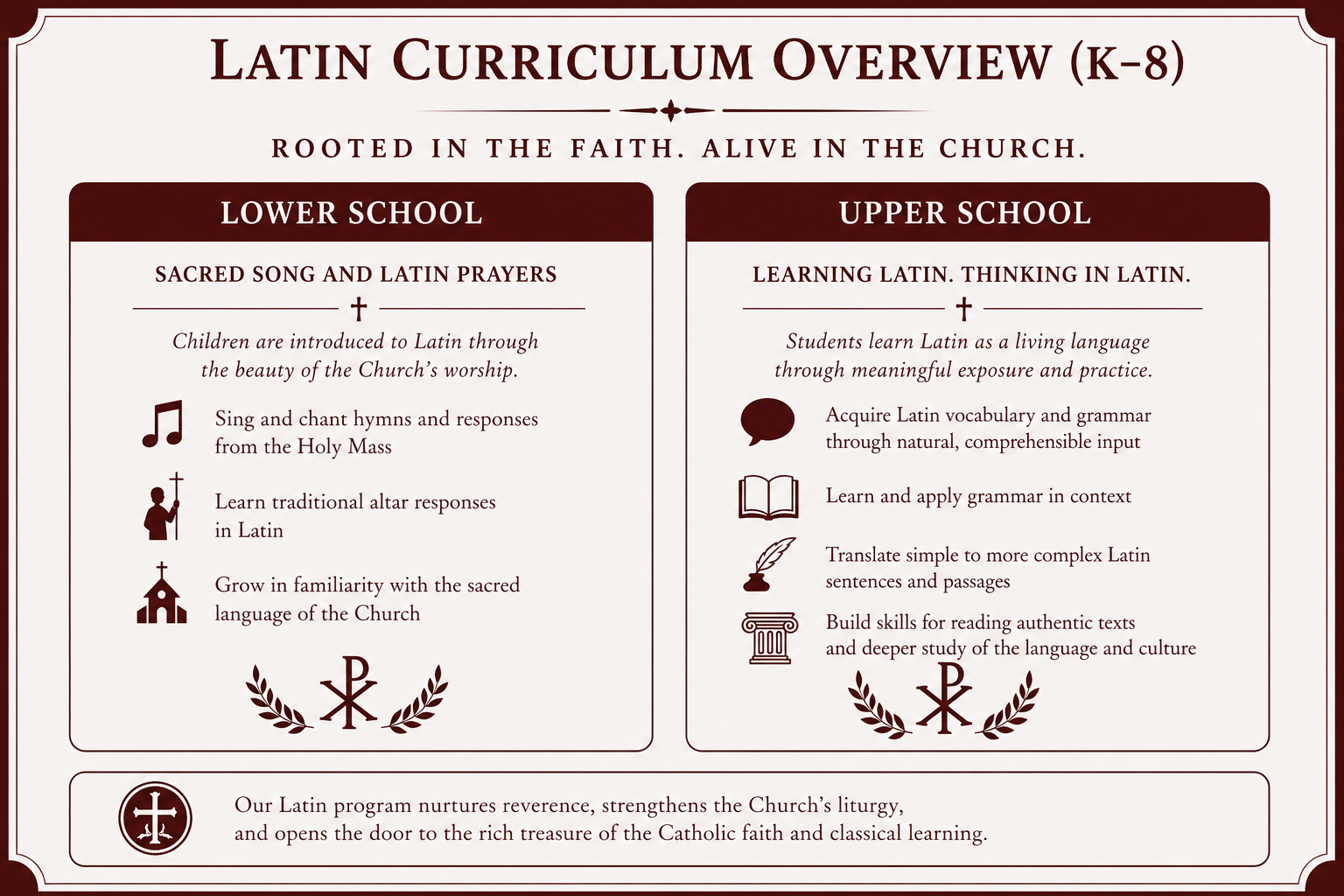
Latin is the language of the Church, the foundation of much of Western civilization, and a key to understanding the intellectual and spiritual heritage of the Christian tradition. Through the study of Latin, students develop precision in thought, discipline in reasoning, and a deeper appreciation for language itself. It opens direct access to the Scriptures, the liturgy, the writings of the saints, and the great works of classical and medieval civilization, helping students encounter the wisdom of the past while strengthening the habits of mind necessary for lifelong learning. It prepares the students to enter into the unknown and the mystery that is God. Which ascends the mind to the sacredness of the liturgy and the mystery of God's truth.
-
The emphasis in the lower grades is not formal grammar instruction, but cultivating comfort, reverence, and familiarity with the sacred language of the Church.
Beginning in sixth grade, students undertake a more formal study of Latin as a language. Through reading, speaking, listening, writing, and translation, students develop the skills necessary to understand and use Latin with increasing confidence.
-
Biblia Sacra Vulgata, Confessiones, Consolatio Philosophiae, Summa Theologiae
ART
-
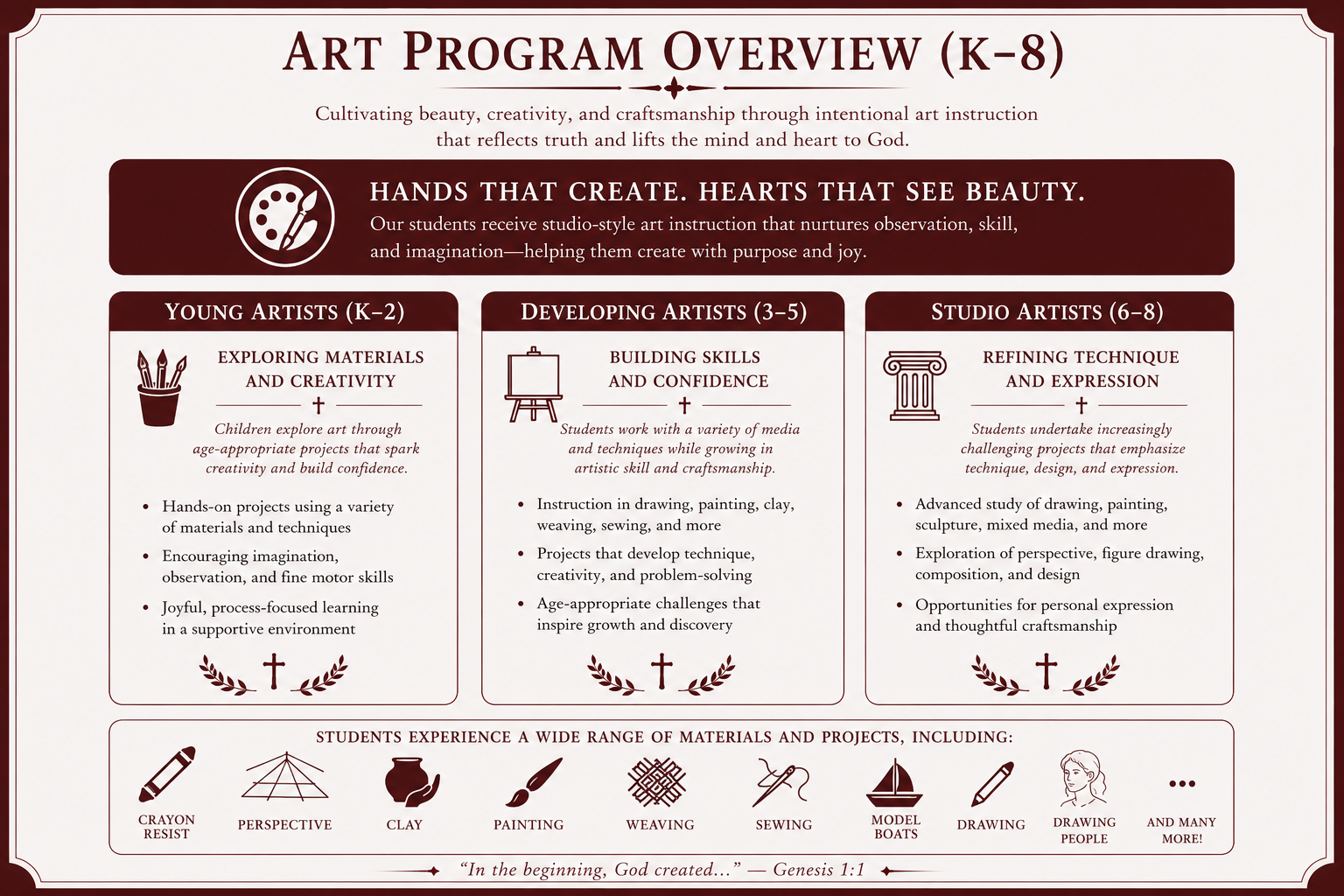
Art cultivates the ability to recognize and create beauty, one of the transcendentals that reflects the goodness and truth of God. The study of art forms the imagination, nurtures creativity ordered toward the good, and introduces students to the rich artistic heritage of the Church and Western civilization. Through drawing, painting, projects, and the study of great works of art, students learn to perceive the harmony, order, and meaning woven into creation, developing both technical skill and a deeper appreciation for the beauty that elevates the soul toward God. And encounter objective beauty which is encountering God who is beauty itself.
-
The emphasis in the early grades is on exploration, joyful creation, and developing familiarity with artistic tools and materials.
As students mature, they begin working with a broader range of materials and increasingly challenging projects that develop artistic skill and craftsmanship.
Upper school students undertake increasingly complex projects that emphasize technical skill, artistic judgment, and personal expression.
-
St. Luke, Fra Angelico, Leonardo da Vinci, Raphael, Michelangelo.
Further Reading
Pope Benedict XV, In Praeclara Summorum
St Basil, Address to Young Men On the Right Use of Greek Literature
Pope Pius XI, Divini Illius Magistri
Pope Leo XIII, Spectata Fides
St Boethius, Consolation of Philosophy
Dante Alighieri, the Purgatorio
Plato, the Republic, Book VII
Flannery O’Connor, the Nature and Aim of Fiction
Josef Pieper, Leisure: the Basis of Culture
Aristotle, the Poetics
St Boethius, De institutione arithmetica
Flannery O’Connor, the Teaching of Literature
St Augustine, De Doctrina Christiana
